
Making Tax Digital Accountants
Making Tax Digital is one of the biggest changes to the UK tax system in recent years, moving many taxpayers away from annual Self Assessment Tax Returns to a more frequent, digital approach.
From April 2026, self employed individuals and landlords earning above the income threshold will need to keep digital records and submit quarterly updates, followed by a final year end declaration, using HMRC approved software.
What is Making Tax Digital (MTD)?
Making Tax Digital for Income Tax (MTD ITSA) is part of HMRC’s move to modernise the tax system, making reporting more accurate, more frequent and fully digital.
For business owners and landlords, it changes how you report your income and how you manage your records throughout the year.

Who Does MTD Affect?
What are the Requirements of MTD?
If you earn income outside of PAYE, there is a strong chance this will apply to you. When it applies depends on your qualifying income at the end of each tax year:
• MTD applies from April 2026, if your income is over £50,000 in the 2024 to 2025 tax year
• MTD applies from April 2027, if your income is over £30,000 in the 2025 to 2026 tax year
• MTD applies from April 2028, if your income is over £20,000 in the 2026 to 2027 tax year
For MTD purposes, income is your total sales or turnover, not your profit after expenses are taken into account.
These thresholds mean many more business owners and landlords will be brought into MTD over the next few years.
Fon
Under MTD, you will no longer file an annual Self Assessment tax return. Instead, reporting becomes a regular, digital process throughout the year.
You will need to:
• Keep digital records of your income and expenses using MTD compatible software such as Xero
• Submit quarterly updates to HMRC summarising your income and expenses, with self employed income, UK property income and overseas property income each needing a separate update
• Submit a final year-end declaration at the end of the tax year to confirm your total income and tax position, this includes any additional income and replaces the current year end Self Assessment tax return
You can choose to keep your records on a spreadsheet. If you do, you will need HMRC approved bridging software to submit your updates.
is a Paragraph Font
When are the Returns Due?
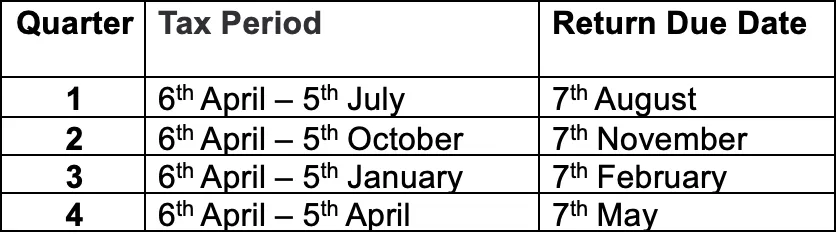
Quarterly updates are submitted to HMRC in line with tax quarter dates. Each submission is cumulative from the start of the tax year, allowing adjustments to earlier figures to be made.
An election can be made to use calendar quarters instead of tax quarters.
The final year-end declaration is prepared to generate your tax liability and replaces the annual Self Assessment Tax Return currently used. This Final Declaration is due by the 31st of January following the end of the tax year.
In line with current requirements, any tax due is payable by the 31st January following the end of the tax year, not quarterly. HMRC have offered assurance this will not change.
How Blackdown Can Help You
We offer four Making Tax Digital services, ranging from a fully managed bookkeeping and MTD solution for those who want everything taken care of, to a lighter touch quarterly review service that offers peace of mind for those who like to manage their own bookkeeping.
If you prefer a more hands on approach, we recommend option one or two, where you manage your own bookkeeping and choose to manage quarterly submissions with or without our support.
If you would rather a fully managed solution, we recommend option three or four, depending on the size of your business and whether you prefer a software based system or a simple spreadsheet approach.
Option One
Year-End Only
• You register for Making Tax Digital
• You prepare and submit your own quarterly updates using the MTD compliant software Xero
• We prepare and submit your year end final declaration
Option Two
Supported Bookkeeping
• We register you for Making Tax Digital
• You complete your bookkeeping using the MTD compliant software Xero
• We check your bookkeeping, prepare and submit your quarterly updates
• We prepare and submit your year end final declaration
Option Three
Simple Quarterly Submission
• We register you for Making Tax Digital
• You (or we) record your income and expenses on a spreadsheet that we provide to you
• We check your entries, prepare and submit your quarterly updates
• We prepare and submit your year end final declaration
Option Four
Fully Managed
• We register you for Making Tax Digital
• We manage your bookkeeping using MTD compliant software Xero
• You raise invoices as appropriate in Xero and send us copies of receipts via an app
eipt
• We prepare and submit your quarterly updates
• We prepare and submit your year end final declaration
Ready to get started?
Get in touch and get set for Making Tax Digital
Frequently Asked Questions
What if my income goes above or below the threshold?
Your obligation to join MTD is based on your income in previous tax years. If your income drops below the threshold, you may be able to leave the scheme, but specific rules apply.
Do I need to change my bookkeeping system?
If you are already using digital software, you may be mostly set up. If you currently use spreadsheets or manual records, you may need to adapt your system to ensure it meets MTD requirements.
Is this going to create more work for me?
Initially, there may be some changes as you get set up. With the right systems in place, it quickly becomes part of your regular routine, makes year end much easier, and helps you feel more in control of your numbers.
Will Making Tax Digital mean I pay tax quarterly?
No, your tax is still due by 31 January following the end of the tax year. Quarterly updates are for reporting purposes only, not payments.
What happens if I do not comply with MTD?
If you do not follow the MTD requirements, you will face penalties from HMRC for late submissions or failing to keep digital records. More importantly, leaving it too late can lead to unnecessary stress and rushed, inaccurate reporting.
When is my first MTD submission due?
If you are using tax year quarters, your first quarterly update will cover the period from 6 April to 5 July and is due by 7 August.
Future quarters follow the same pattern:
• 6 April to 5 July, due by 7 August
• 6 July to 5 October, due by 7 November
• 6 October to 5 January, due by 7 February
• 6 January to 5 April, due by 7 May
It is important to be set up in advance so you are ready to report from day one.
'We make accounting easy and approachable, so you can focus on what matters most to you,
your business'
- LISA HAY FCA
New on the blog...

Paid a Business Expense Personally?
Paid for a business expense from your personal account? Find out what you may still be able to claim, what records to keep and what to do next. ...more
Why An Accountant
September 22, 2026•5 min read

Trivial Benefits for Directors: How the £300 Tax-Free Allowance Works
Limited company director? Learn how HMRC’s trivial benefits rules can allow up to £300 of qualifying tax-free benefits each year, including the £50 limit and key rules. ...more
Why An Accountant
September 15, 2026•4 min read

Side Hustle Tax UK: When Do You Need to Tell HMRC?
Making money from a side hustle? Find out when you need to tell HMRC, how the £1,000 trading allowance works and when you may need Self Assessment. ...more
Why An Accountant
September 08, 2026•4 min read
FREE DOWNLOAD
Headline that hooks people in, gets them excited and makes them want to sign up.
At Blackdown Accounting, we believe in business with integrity.
We are passionate about supporting business owners to achieve financial confidence and fostering a deep love for their business.
Our Core Values: Honesty, Respect, Trust & Teamwork – the foundation of everything we do.
© Copyright 2026 Blackdown Accounting Ltd - Privacy Policy - Terms & Conditions
Facebook
Instagram
LinkedIn